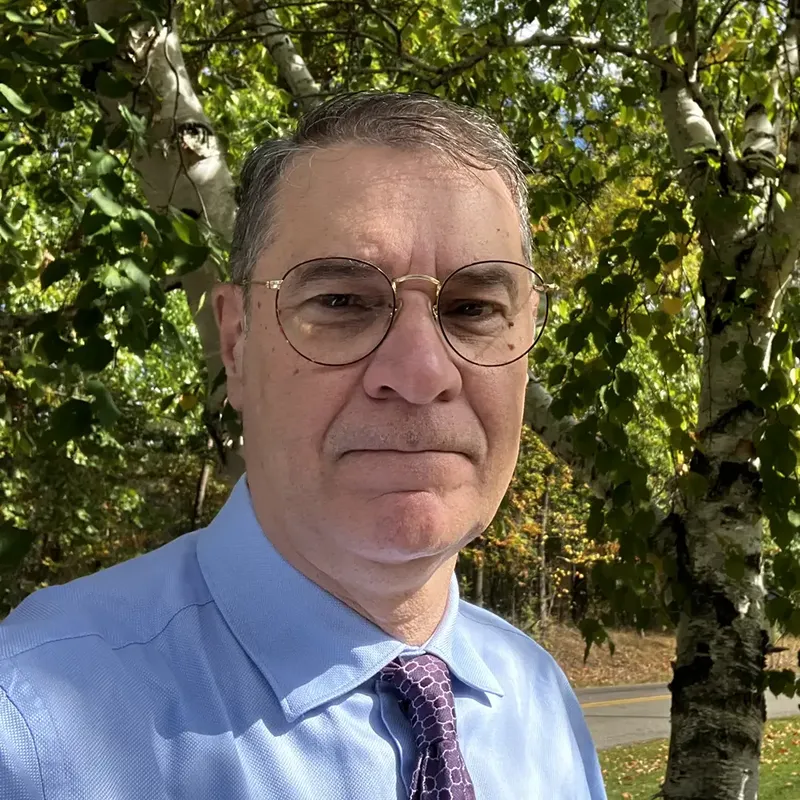
At age 60, retired U.S. Army Major Donald Michael, MSW ’26, was not the stereotypical social work student — but he would also say that he wasn’t the stereotypical military recruit, either. His career path may not be conventional, but it has been anchored by his core values: grace, gratitude and service leadership.
Michael was a journalism major at Michigan State University when friends encouraged him to take the officer entry exams at the campus ROTC office. He did not, he said, look the part. “If you could have imagined me walking in there the first day. I had this old Cleveland Indians baseball hat on, and I had these horn-rimmed glasses that were taped up.”
He did, however, have stellar aptitude scores. Even so, the program’s senior officer — a colonel who summed him up in a single look — discouraged him from joining. That was when a sergeant major intervened, creating what Michael calls a life-defining moment of grace.
“Because of that senior NCO [non-commissioned officer], I was able to get through ROTC and became a second lieutenant in the Army of the United States. Somebody saw something in me, and it changed my life. And throughout my 28 years of commissioned service, every time somebody saluted me, I would always return the salute and say, ‘thank you.’ I never forgot that moment of grace.”
Michael started as a platoon leader in the Corps of Engineers in Desert Storm. After earning a degree in occupational therapy and getting licensed in three states, the Army transferred him to the Medical Specialist Corps, where he rose to the rank of major. Along the way, he earned a master’s in theology. Later, as a rehab director at what is now the Mid-Michigan Regional Medical Center, he deployed the same service leadership he learned in uniform.
“Leadership by example is not just one way to lead; it's the only way. So if my colleagues had to work weekends, they would occasionally see me work weekends.” He would routinely pick up weekend shifts and work late, so his colleagues could attend their children’s recitals and family functions. “I had a 90% retention rate when it came to my employees because my colleagues really meant a lot to me.”
As a rehab director, Michael was also able to see firsthand the impact social workers make.
“I just fell in love with the social workers. They were on top of everything, the unsung heroes. They kept me out of trouble, they kept the nursing team out of trouble and they definitely kept the physicians out of trouble because they were looking out for the patients’ interests. And that is what intrigued me. I was honored to work with them.”
And then he got sick. In 2019, Michael was diagnosed with cancer linked to his service during Desert Storm. The intense toll of chemotherapy, combined with neuropathy and a loss of hearing, forced a medical retirement from the intensity of his 60-to-80 hour-a-week OT career. After VA and vocational rehab, he began his next chapter: social work.
Michael brought his guiding values to the School of Social Work. “I thought I could pay something back; I could pay something forward. So, I was so happy to get accepted at U-M.”
His approach to social work was also deeply shaped by his 28 years in uniform. Overseas, he had witnessed severe poverty and disease, served in foxholes, and lost colleagues. Those experiences gave him a profound sense of perspective, as well as the ability to sit with someone’s pain while keeping the broad, structural issues in view.
And as a 60-year-old grad student, his personal experience and perspective made him something of an anchor for his cohort. He was energized by his classmates’ intense drive and dedication, while he served as a steadying presence — an example of what it means to show up, put the effort in and do the work.
“Those students helped me put everything into this education,” he said. “Sometimes they thought of me as the sage with all my experience, but I got as much wisdom from them as hopefully they acquired from me. And I was always, always grateful. I mean, I was always the most grateful person in the classroom."
Michael's field education was at Catholic Charities of Jackson, Lenawee, and Hillsdale Counties, working with substance use disorder and behavioral health counseling services under mentor Debra Wright, MSW ’95.
“It was a phenomenal education. I helped with assessments and interpersonal counseling, and I learned a lot not only about addiction, but about pharmacology,” he said. “I love the passion of Catholic Charities because they didn’t care how you got there — once you walked in, they wanted to take care of you. Everyone is a person of worth and a person of dignity.”
Concurrent with his MSW studies, Michael worked as a part-time probation officer in Hillsdale County. He continues in that role today, serving as the only district court probation officer in the state of Michigan focusing exclusively on veterans.
Michael graduated in May and is determined to fight for vulnerable rural populations, specifically veterans and those facing substance use disorders. He credits his accomplishments to the multigenerational support surrounding him: his wife, Karen, his children, and his social work classmates.
“People matter to me,” Michael said. “And social work has become a beautiful avenue for this last quarter of my life.”